

Call for Essays: Spiritual Drip
We're making a print magazine about faith, clothing, fashion, and identity formation in Nigeria and Ghana. We'd love to read your manuscripts!

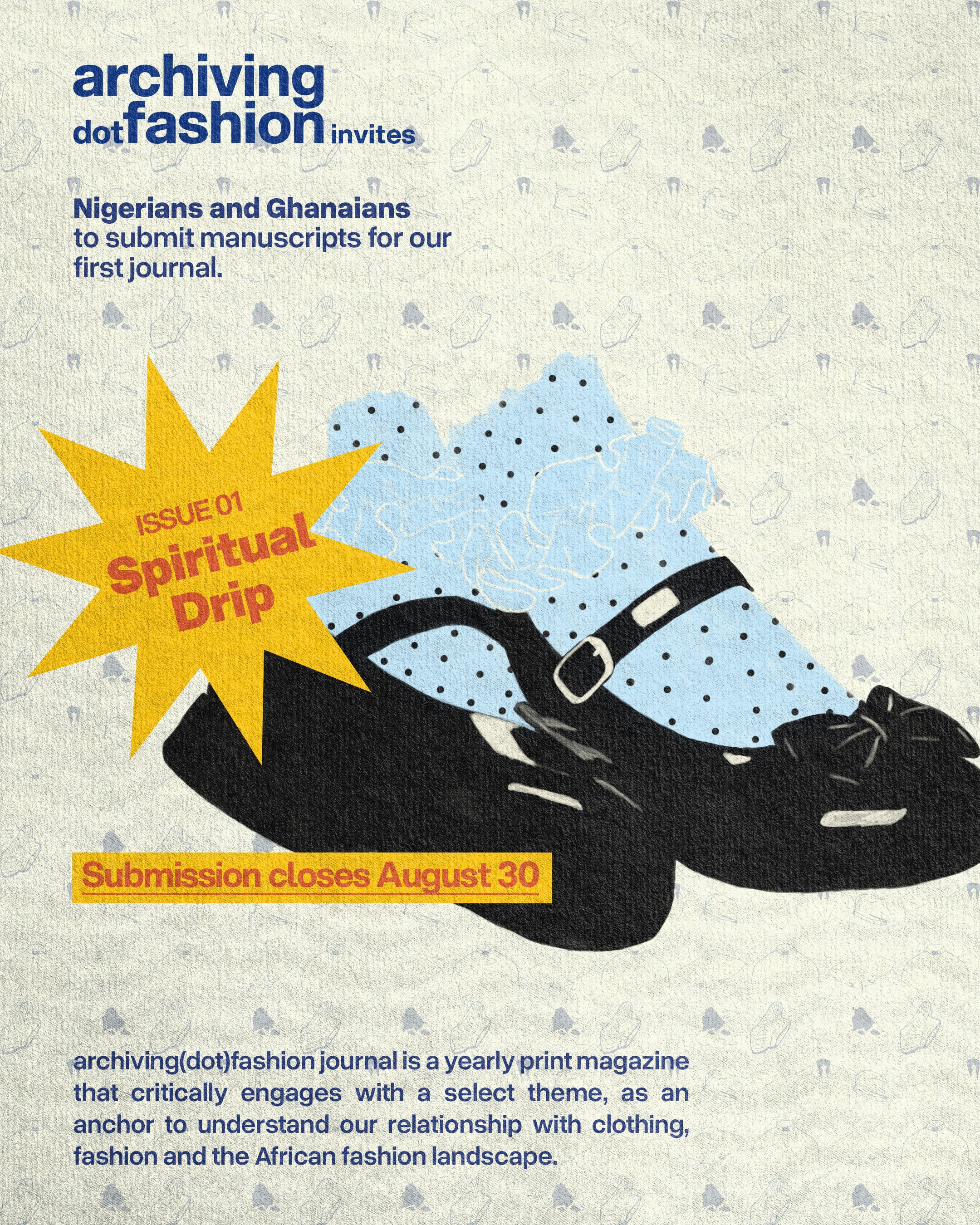
Why Spiritual Drip?
In October 2025, a large number of Nigerians active on social media (read: Twitter) were incensed by others’ participation in the Dress Like Your Miracle prompt of the Hallelujah Challenge. At the time, the Hallelujah Challenge had been running for 8 years and had previously received online criticism. However, it was different this time around. Some of the strongly worded sentiments that followed Nigerians’ participation in this expression of their desires typified it as greed. Interestingly, the desires expressed in this virtual performance of personal wants and needs were similar to prayer points regularly echoed in churches. Observing this play out on the internet, and led by a question our editorial team have been passively asking for over a year, “how do Nigerians and Ghanaians relate to faith historically and contemporarily, and how is this reflected in our fashion and style?” crystallised our decision to explore Spiritual Drip.
archiving(dot)fashion journal is a yearly print magazine that critically engages with a select theme, as an anchor to understand our relationship with clothing, fashion and the African fashion landscape. The theme for our first journal issue is Spiritual Drip, and we’re inviting Nigerians and Ghanaians to submit manuscripts.
In this issue, we are troubling the #SundayBest conversation about African style to explore the complexity of our relationship with religion (specifically Christianity) and clothing. Religion is a big part of our lives and identities in these two West African countries, and despite the growing global influence of West African style, the specific intersection of Christianity and dress remains largely anecdotal. How does faith shape our wardrobe in and outside religious contexts? Conversely, how does our wardrobe dictate our performance of faith? Beyond trends, what overlapping ideas are present in Nigerian and Ghanaian relationships with Christianity, fashion, and being?
We’re interested in stories at the intersection of [the lack of] faith in the Christian context, clothing, fashion and identity formation in Nigeria and Ghana. We welcome submissions that fall into one of four sub-themes and are open to your interpretation of Spiritual Drip within these themes.
Church in contemporary fashion design.
How are contemporary fashion designers having conversations about Christianity, and how does this complicate our ideas of the faith? What religious themes do they play with, and what’s left unsaid in the breadth of ideas prominent in their designs? How have religious doctrines around dress informed tailoring techniques, silhouettes, garment construction and financial bets designers take? Examples of this are Meji Meji’s archival commentary on Nigerian Christianity, in which streetwear serves as a receptacle for hope and dreams, and Hertunba’s “Sunday Culture” collection, which emphasises the glamour of getting dressed for a Sunday service.
Church style and larger culture.
How do young women (and men) navigate the uncertainty of what’s appropriate to wear to Church? What historical precedents inform the use of uniforms in some Churches, and in the absence of a clearly defined uniform, how are traces of uniformity in style showing up in other Churches? How do Church merch like t-shirts, commemorative print clothing, and wristbands, for instance, act as artefacts of belonging and shared identity outside the walls of the Church? How do these labelled artefacts inform how people carry themselves in public, and subtly influence or advertise for Churches? What design considerations or philosophies are designers of these merch thinking of and drawing on to inform their process?
Church style and personhood.
What are your personal stories showing how you split your style between Church and the world? How do you navigate that tension and contradiction? How is the style of figures (e.g. pastors’ wives, pastors, church leaders) imposed, and how does that show up in people’s (read: congregation) interaction with clothes and clothing items? How are figures opposing and/or subverting traditional ideas of style in their wardrobe, using it as a gateway to drawing in a specific demography as their audience? How does the looming presence of a figure’s style in people’s dressing influence the fashion economy in the styles that are trendy and/or fabrics in circulation?
The internet is a big part of our lives today, so we are open to writing that expands our understanding of how people use the affordances of digital technologies to signal and perform their [lack of] faith. In addition to the Dress Like Your Miracle trend of the Hallelujah Challenge, examples of story directions include using Christian religious style as an aesthetic to grow an online audience, using gospel music for get-ready-with-me videos, exploring AI as a style assistant, and poking fun at religious theatre.
We welcome story formats that may not be typical of fashion writing. An example of this is a satirical guide to dressing like your miracle, which is critical of the trend and of participation in it.
The examples listed above are suggestions to inspire ideas on the direction your manuscript can take. Your manuscript is not limited to these examples. As a reminder, the central question we want to explore in Spiritual Drip is: How have Nigerians and Ghanaians related with the Christian faith both historically and in contemporary times, and how is this relationship reflected in their fashion and style? We’re interested in stories that lead with curiosity and care, and take us on a journey.
Who Can Submit?
Anyone living in Nigeria or Ghana for at least 8 months in a year. We’re interested in stories informed not only by observation and critical analysis, but also by lived experience on the continent. Personal, historical, communal, and contemporary stories that are exploratory and offer a better understanding of the Nigerian and Ghanaian experience are welcome.
As a publication that leads with research, we have a bias toward rigorous non-fiction stories (even when personal) that are original, well-reported, critical and published exclusively in the journal. We welcome submissions from journalists, storytellers, writers, individuals, archivists, independent researchers and anyone who has a story to tell at the intersection of fashion and Christianity.
We’re accepting 8 written essays and want a diversity of perspectives and story formats from long-form writing (historical or contemporary) to individual stories to community and fashion brand analysis. We’re equally interested in experimental storytelling formats and will look out for them in the submissions.
For submissions that lean heavily on historical research, the archiving(dot)fashion editorial team is open to providing additional research support where needed during the editing process.
Important: This is only a call for written stories. We will announce commissions for photo stories after the written stories have been finalised.
How to Submit?
Send your submission to info@archiving.fashion by August 30, 2026. We recommend that the subject line for your submission email be: [Pitch] [Submission Title]. For instance, your email subject can look like this: “[Pitch] The Devil Wears Kaunda”. For questions about this submission, you can write to the same email address with the subject line: “[Question] Spiritual Drip”.
We’d like to see the following information in the body of your email:
Completed essay between 1,500 - 2,500 words in a Word Document,
The city in Ghana or Nigeria where you live and work,
A paragraph describing why this story matters to you, what you’re aiming for with the story and how this fits into the larger theme of Spiritual Drip. We don’t expect you to be a Christian to write, but we’d love to know why you care about the story.
Important: We’d love to read stories informed by your lived experience, and will not consider AI-generated manuscripts.
Timeline and Compensation
Each writer whose manuscript is accepted will receive between $80 and $100 in compensation, depending on the depth of their submission.
The deadline to submit your manuscript is August 30, 2026, at 11.59 PM WAT1.
Meet the Team
Poster Design direction: Elizabeth Akpan, Princess Ebi, Sherifddin Apampa, Adé Abegunde

Poster Design: Sherifddin Apampa
Journal team: Elizabeth Akpan, Princess Ebi and Olachi Olua
We reviewed this call for essays and made a change to the submission deadline from July 1, 2026 to August 30, 2026.
🧡
Please, can you give a sample piece that you love?